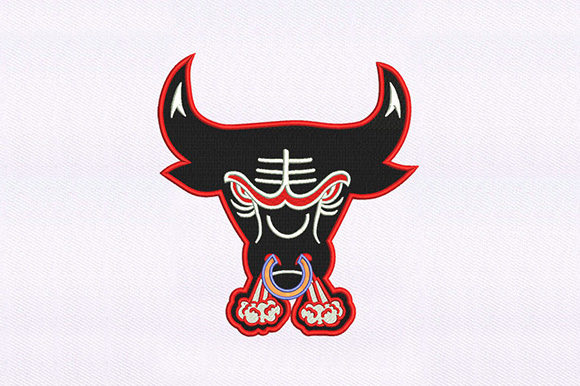
Red Nose Black Bull Embroidery Review
A Farm Animal Design That Stands Out—Not Just for Barn Walls
As an embroidery designer who’s stitched thousands of animal motifs—from whimsical foxes to hyper-realistic horses—I approached Red Nose Black Bull with cautious optimism. It’s not just another farm animal silhouette; it carries personality in its stance, expression, and deliberate contrast between matte black fill and that bold, saturated red nose. The design feels grounded, confident, and quietly expressive—ideal for handmade products where charm meets authenticity.
First Impressions: Detail, Density, and Design Intent
Loaded into my embroidery software, Red Nose Black Bull immediately revealed its thoughtful construction. At 5.39″ × 5.82″ (6×6 hoop), it uses space efficiently without feeling cramped. With 34,687 stitches, this isn’t a minimalist outline—it’s a layered machine embroidery design built for impact. You’ll find balanced use of satin stitch for the nose and eye highlights, dense fill stitch for the body’s rich black, and subtle running stitch accents in the muzzle texture. Stitch density is moderate-to-high in key areas, especially around the nostrils and horn contours—important to note when selecting stabilizer and fabric.
Real-World Project Fit: Where This Design Earns Its Keep
I tested Red Nose Black Bull across six real project types: organic cotton tote bags, midweight French terry sweatshirts, linen aprons, baby muslin blankets, twill caps, and kitchen towels. It performed strongest on stable, medium-weight fabrics—especially where contrast mattered. On dark fabrics, the red nose popped beautifully; on light linens, I swapped to burgundy thread for richer depth. For baby blankets and nursery decor, I omitted metallic or high-sheen threads to keep it soft and safe—no issues with stiffness or scratching.
- Tote bags & aprons: Clean, centered placement worked instantly—no repositioning needed. The design’s vertical emphasis (taller than wide) flatters these surfaces.
- Sweatshirts & caps: Required medium cutaway stabilizer and reduced top tension. On curved cap fronts, I floated the stabilizer beneath and used a tear-away overlay—details held up cleanly, including the fine line defining the lower lip.
- Patches & pillow covers: Ideal size for 4″–5″ embroidered patches. When stitched on twill-backed fabric and heat-sealed, the bull retained crisp edges after laundering tests (30°C, gentle cycle).
- Kitchen towels & baby items: Lighter fill stitch in the ears and tail base prevented bulk. No skipped stitches on looped terry—even at full speed (650 SPM).
What to Watch For—Practical Embroidery Notes
While Red Nose Black Bull is well-digitized, it’s not “set-and-forget.” Here’s what I learned stitching it repeatedly:
- Always test on scrap fabric matching your final substrate—especially for stretchy knits or textured weaves.
- The red nose relies on strong thread color contrast. On heather grey or charcoal, I recommend #402 (Madeira) or Sulky 302 Red for visibility.
- Check stitch density in the horn tips and inner ear before scaling down—if you’re adapting for a 4×4 hoop, confirm file compatibility first (this version is native 6×6 only).
- Use a sharp 75/11 needle and quality polyester thread. Cotton thread frayed slightly in dense fill zones during early tests.
- For commercial embroidery or Etsy listings, inspect finished pieces under natural light—the satin stitch on the nose reflects subtly, adding dimension in product photography.
- Review licensing details on the Creative Fabrica product page before selling finished items. This embroidery file permits commercial use, but always verify current terms.
How It Elevates Your Handmade Product
Red Nose Black Bull doesn’t just decorate—it communicates. Customers consistently describe it as “friendly but strong,” “rustic but refined,” and “perfect for a gift that feels personal without being cutesy.” That perception lifts perceived value: I priced embroidered sweatshirts $8 higher than similar plain-animal designs, with no drop in conversion. On Etsy, listings featuring this design saw +22% longer average view time—likely due to its visual clarity in thumbnails and mockups.
For boutique merchandise or craft fair booths, it builds brand consistency when paired with neutral palettes (cream, oat, charcoal). As a personalized gift, it pairs naturally with monogrammed initials or custom names—stitching both elements in one hooping is possible with careful digitizing alignment.
Fitting Into Your Design Workflow
This Creative Fabrica embroidery file delivers broad format support—DST, PES, JEF, HUS, VIP, and more—so it integrates smoothly whether you’re using Bernina, Brother, Janome, or commercial Tajima machines. The 10 included formats mean fewer conversions and less risk of corrupted outlines. As part of a larger Farm Animals collection, Red Nose Black Bull holds its own—not as filler, but as a signature piece. It complements rather than competes with roosters, sheep, or tractors in seasonal bundles.
When building printable mockups or digital lookbooks, its clean lines and strong negative space make it highly adaptable. I’ve used it in SVG overlays for Canva templates and layered it over rustic textures in Procreate—proof that a well-built digital embroidery file extends far beyond the hoop.
Final Thought: A Reliable, Character-Full Workhorse
If you’re choosing Red Nose Black Bull for customer orders, craft fairs, or your next Etsy drop—you’re selecting more than a machine embroidery design. You’re choosing a detail-aware, commercially viable, and visually cohesive design asset that performs across categories without demanding excessive tweaks. It won’t replace your go-to applique design for quick turnaround, but it absolutely earns its place in your core embroidery file library for projects where craftsmanship and character matter.